Blog / Affiliate marketing
How Do You Make Money with Affiliate Marketing on MyLead? (Part 1)
This article is updated regularly
Last update:
09 March 2026
Making money with affiliate marketing means earning a commission for promoting other companies' products or services. On MyLead, the path runs through a free publisher account, a campaign chosen from the catalog, a generated tracking link, and consistent promotion. The full process follows five steps: understanding your audience, selecting programs, creating content, promoting links, and monitoring earnings.
This guide walks through each of the five steps in practice — from reading your audience to tracking conversions — so you can launch your first affiliate marketing campaign on MyLead with a clear plan.
What you'll learn from this article:
how to analyze your target audience and tailor your affiliate offers,
how to select affiliate programs that genuinely fit your niche,
which promotion channels convert best — blogging, social media, paid ads, and email,
why tracking earnings and adapting your strategy drives long-term results.
What are the steps to making money with affiliate marketing?
Making money with affiliate marketing on MyLead is a five-step process where each step feeds the next: audience research shapes which programs you pick, your programs shape the content you create, and content decides where you promote and what you track. Done in order, the sequence compounds results instead of scattering effort.
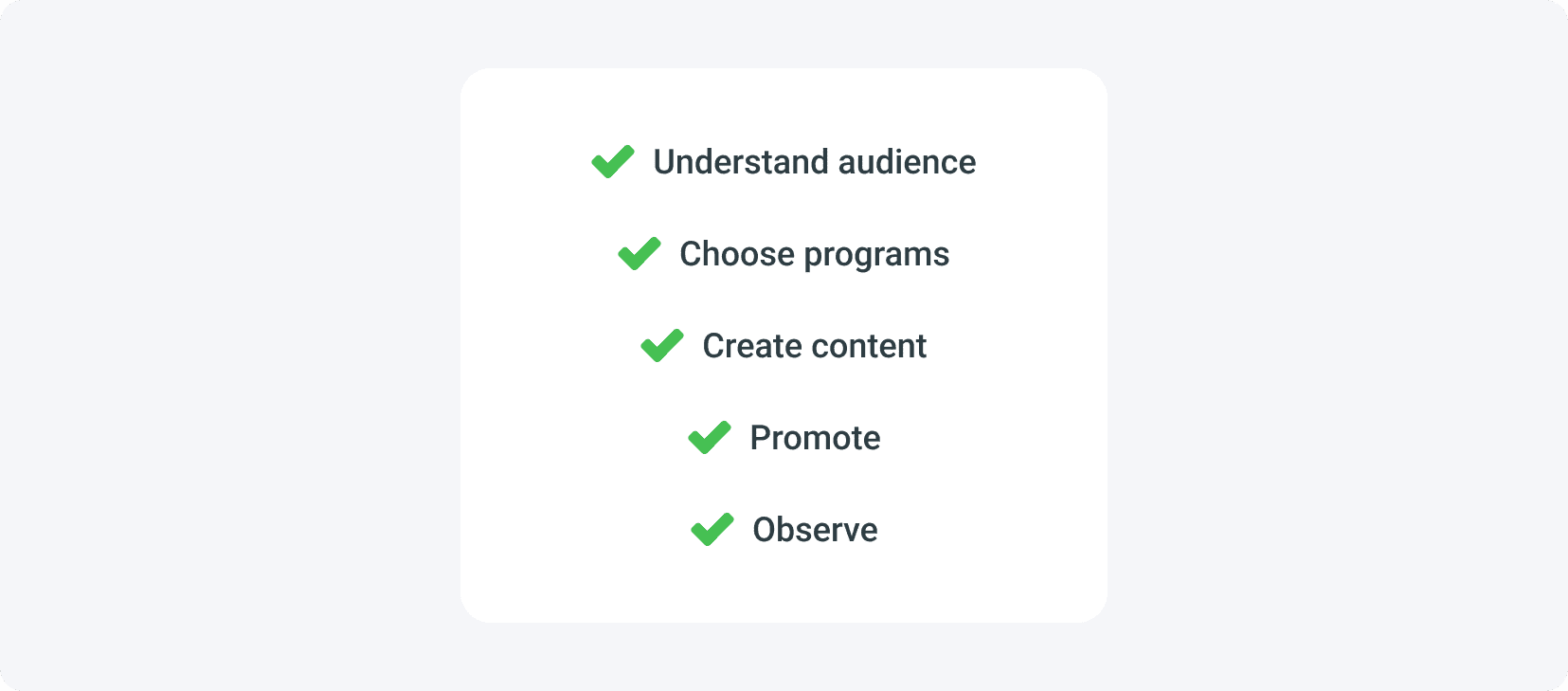
Treat it as a sequence, not a checklist to rush. Skip audience research and your program choice misfires; skip tracking and you never learn which channel pays. These five steps turn affiliate marketing from guesswork into a system you can scale on MyLead.
How do you understand your target audience?
Understanding your audience means identifying the interests, preferences, and pain points of the people you want to reach. In affiliate marketing, that insight decides which offers will resonate. A fashion-focused following, for instance, responds to trend-driven brands and styling tips — not banking or deposit products that sit outside their world.

Picture a fashion following. They care about new trends, emerging labels, and insider styling advice. Align your fashion affiliate programs with those aspirations — partner with trendy clothing stores, exclusive launches, or must-have accessories instead of pushing unrelated financial offers.
How do you choose the right affiliate programs?
Choosing the right affiliate programs means matching offers to what your audience already loves or aspires to buy. The strongest matches come from brands inside your niche — clothing retailers, beauty companies, or accessory labels for a fashion audience. The closer a program fits your content, the higher the conversion rate.
If sustainable fashion is your angle, promote eco-friendly clothing lines or ethical brands that match your values. Not sure where to begin? Read our guide on how to choose the best affiliate network, then browse the best affiliate programs on MyLead.
Browse the full campaign catalog for your niche:

How do you create compelling content that converts?
Compelling content captures attention and inspires action while featuring affiliate products naturally. The right format depends on your audience — blog posts and SEO guides for readers, short videos for Instagram or TikTok viewers. Content that pairs genuine value with honest recommendations builds the trust that drives conversions.
Use your own voice and aesthetic. Share personal anecdotes, style guides, or behind-the-scenes glimpses so recommendations feel authentic, not salesy. Structuring posts around search intent helps too — our SEO checklist for engaging content shows how to rank and convert at the same time.
Where should you promote your affiliate links?
Affiliate links perform best across several channels: blogging, social media, paid advertising, online forums, and email marketing. Each reaches a different slice of your audience. Around 65% of affiliate marketers drive traffic through blogging and over 67% engage customers on social media, so a multi-channel mix usually beats a single source.
Blogging
Blogging is the most common affiliate traffic source, used by roughly 65% of marketers. A blog lets you weave affiliate links into reviews, tutorials, and buying guides that earn organic search traffic over time. Product reviews convert especially well, since around 9 in 10 consumers check reviews before buying.
Optimize posts for search engines to pull in free traffic — see how in our guide on how to make money blogging. Niche-specific angles work well:
Fashion bloggers — display store banners and link to clothing, accessories, and footwear brands you personally use.
Culinary bloggers — link to kitchen gadgets and specialty ingredients inside recipe posts.
Cosmetic bloggers — recommend skincare and makeup stores within tutorials and routines.
Lifestyle bloggers — curate gift guides like "Gifts for Him" or "Holiday Gift Guide" with affiliate links.
Parenting bloggers — compile must-have gadgets, toys, and educational products with honest, experience-based reviews.
Book bloggers — link to online bookstores in themed reading lists such as "Best Summer Reads."
Finance bloggers — share deposit offers and money-management tips alongside relevant financial products.
Social media
Social media is the most popular promotion method, with over 67% of affiliate marketers engaging customers there. Platforms like Instagram, Facebook, X, and LinkedIn suit visual, shareable posts. Stories, reels, and short videos that show a product's benefits — paired with active replies to comments — build the credibility that converts followers.
Paid advertising
Paid advertising buys reach fast through channels like Google Ads, Facebook Ads, Instagram Ads, and LinkedIn Ads. It needs budget and testing, so it suits publishers past the beginner stage. Success hinges on tracking metrics — click-through rate (CTR), conversion rate, and return on ad spend (ROAS) — and optimizing creatives against them.
Pick channels that match your offer and audience; our breakdown of the best paid traffic for CPA offers shows where the budget works hardest.
Online forums
Online forums and niche communities let you reach a tightly targeted audience. Lead with value: answer questions, share useful resources, and add affiliate links only where they genuinely help. Transparency and consistent participation build the trust that turns forum members into buyers, so avoid spammy drops that get you banned.
Email marketing
Email marketing nurtures subscribers with valuable content, product recommendations, and exclusive offers. Segmenting your list by interest and behavior keeps messages relevant and lifts conversions. It stays one of the highest-ROI channels, but EU audiences require GDPR compliance — explicit consent, a clear opt-out, and a transparent privacy policy.
Secure explicit consent before adding anyone and document how you handle their data. Need subscribers first? Learn how to build an email list for affiliate marketing from scratch.
How do you monitor and optimize your earnings?
Monitoring earnings reveals which campaigns and channels actually pay. MyLead's publisher panel tracks clicks, conversions, and payouts in real time, so you can see when you cross the payout threshold and which links perform. The goal is not only hitting a target — it is learning what works and shifting effort toward it.
What converts on Instagram often flops on X, so adapt per platform. Watch which formats your audience rewards — curated gift lists or in-depth reviews — and double down. Track the right signals with our guide to key metrics and analytics tools.
Want a dashboard that does this out of the box? Create your free MyLead publisher account and start tracking from your first campaign.
Key takeaways
MyLead is free for publishers — you earn only from commissions, with no startup fees.
The five-step path — audience, programs, content, promotion, tracking — turns affiliate marketing into a repeatable system.
Blogging (≈65%) and social media (≈67%) are the most-used promotion channels; a mix beats a single source.
Email marketing converts well but demands GDPR compliance for EU subscribers.
Without tracking you cannot tell which channel pays — monitor earnings from your first campaign.
FAQ
1. What is the most important first step in affiliate marketing?
Understanding your audience. Identify your followers' interests and pain points before choosing products, so every offer you promote genuinely fits them.
2. Where are the best places to promote affiliate links?
The most effective channels are blogging, social media (Instagram, Facebook, TikTok), paid advertising, online forums, and email marketing — matched to your audience's habits.
3. Do you need paid advertising to succeed?
No. Many publishers build income with free methods like SEO-optimized blog posts, organic social content, and helpful participation in online forums.
4. What rules apply to email marketing?
For EU residents, GDPR compliance is mandatory: explicit consent before sign-up, a clear opt-out mechanism, and a transparent privacy policy.
5. How quickly will you start making money?
There is no overnight result. Consistent effort and tracking which methods convert let you optimize toward a sustainable income over weeks and months.
Summary
Making money with affiliate marketing on MyLead comes down to a disciplined five-step loop: know your audience, pick fitting programs, create authentic content, promote across the right channels, and track every result. Master the loop and your first commissions grow into a sustainable income. Ready for more? Continue with Part 2 of this guide.
New to the basics? Explore our affiliate marketing for beginners guide:

Have any questions? Feel free to reach us through our channels.