Blog / Affiliate marketing
How Do You Build an Email List for Affiliate Marketing?
This article is updated regularly
Last update:
10 June 2025
Building an email list for affiliate marketing means collecting subscriber addresses through opt-in forms, then nurturing them with valuable content that promotes affiliate offers. The process relies on five steps: choosing an email provider, adding sign-up forms, automating campaigns, producing quality content, and offering exclusive material. Email remains one of the highest-converting channels for publishers in 2026.
This guide walks you through each step of building an email list, from your first opt-in form to advanced automation. You'll also get practical best practices that keep subscribers engaged and protect you from spam complaints.
What you'll learn from this article:
how to choose an email marketing provider and stay compliant with anti-spam laws,
where to place opt-in forms so visitors actually subscribe,
how to automate a welcome campaign and keep your list engaged,
which best practices protect you from spam complaints and unsubscribes.
How do you build an email list for affiliate marketing?
Building an email list for affiliate marketing starts with a website or blog, an email marketing provider, and a visible opt-in form. You collect addresses from visitors who agree to receive messages, then send them automated, valuable content that promotes affiliate offers. Email gives you a direct, algorithm-free channel you fully own — unlike social media.

Back in 2019 there were already 3.9 billion active email users worldwide — close to half of the global population of 7.8 billion. Checking email is still one of the first things people do every morning, which makes it a reliable way to reach an audience and widen your income as a publisher. New to this? Our guide on affiliate marketing for beginners covers the fundamentals.
Sign up to MyLead for free and pair your email list with high-converting affiliate campaigns from the start.
Which email marketing provider should you choose?
An email marketing provider is software that stores your subscribers, builds emails in a visual editor, and sends them automatically to your list. Choose one that offers opt-in widgets, automation, and built-in compliance tools. After you create your website or blog, integrating a provider is the first technical step toward a working email list.
Before you send a single message, follow the legislative rules around email. You need explicit permission from every subscriber, because many countries enforce anti-spam laws that govern how you add people to a list and contact them. Every email must include a visible opt-out option — place it in the footer so people can unsubscribe anytime. No site yet? Here's how to start a blog to host your forms.
How do opt-in forms help grow your email list?
An opt-in form is an online field where visitors enter their name and email address to subscribe to your list. Placed in a visible spot — sidebar, footer, or pop-up — it converts anonymous traffic into subscribers. Most email providers supply ready widgets you embed on any page, so test different timings and positions to find what converts best.
Visibility is everything: a form buried below the fold collects far fewer signups than a timed pop-up or a prominent sidebar box. Experiment with placement and pop-up timing, then keep the version that brings the best results. For more tactics, see our guide on growing your email marketing list.
How do automated email campaigns work?
Automated email campaigns send pre-written messages to subscribers on a set schedule after they sign up. You build the flow once, and the provider delivers each email at the right moment — saving time while keeping your audience engaged. A welcome campaign is the standard starting point: it greets new subscribers and explains what your site offers.
A campaign is a series of emails built around one topic that informs and educates your audience. Start with a welcome sequence, then plan themed campaigns that deliver consistent value. Ready-made structures speed this up — browse proven affiliate marketing email templates before writing your first flow.
How do you create email content that keeps subscribers?
Quality content is what makes subscribers open your emails again. Research fresh information in your niche, focus on what your audience cares about, and deliver it consistently. Exclusive content — material available only to subscribers — gives people a concrete reason to join and stay. Storytelling turns plain updates into messages people actually read.

Keep your audience entertained and informed, and they'll keep opening your messages. Offer subscriber-only content — a guide, discount, or early access — as a lead magnet that grows your list. When you sit down to write, learn how to write engaging emails for affiliate marketing that sell without sounding pushy.
What are the best practices for affiliate email marketing?
The core best practices for affiliate email marketing are personalization, consistency, and restraint. Use each recipient's name, send on a predictable schedule, and never overload inboxes — once or twice a week is enough. Above all, share useful information instead of hard-selling, and keep affiliate links to a minimum so subscribers stay loyal.
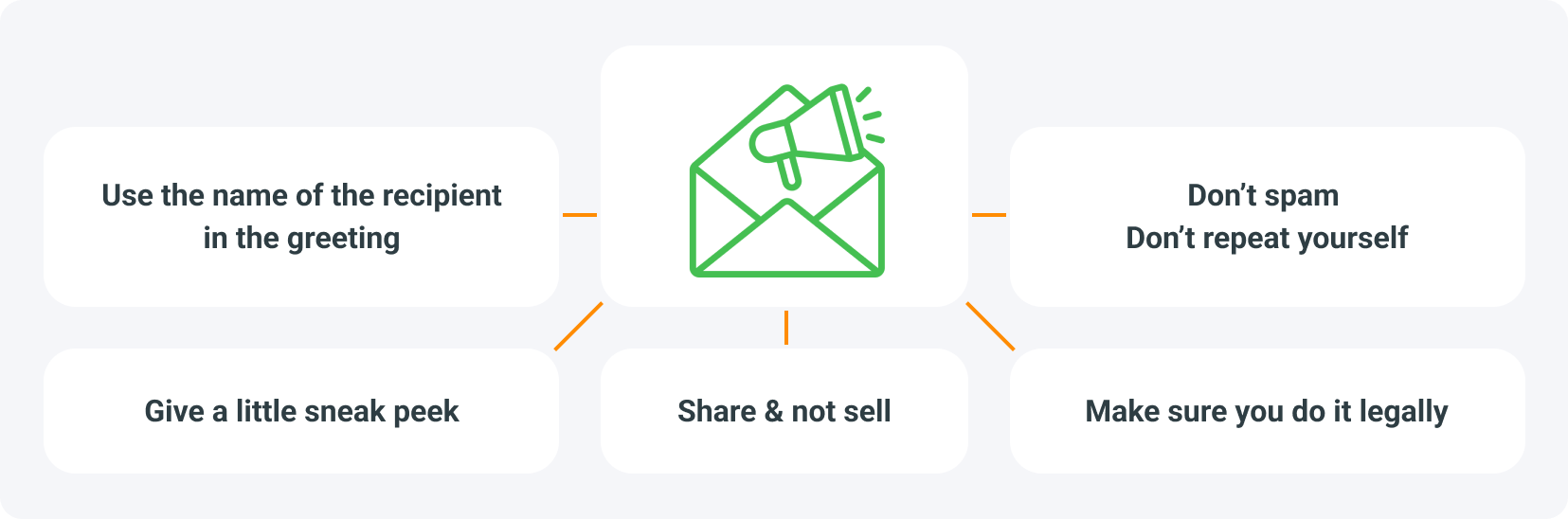
Use the recipient's name — personalization makes emails feel personal and builds connection; pick the first or last name based on your audience.
Give a sneak peek — publish your latest newsletter on your site so visitors preview the content and feel encouraged to sign up.
Don't spam — send consistently on set days and times; once or twice a week is plenty, since more feels annoying.
Don't repeat yourself — bring new information each time, or subscribers will start ignoring and unsubscribing from your emails.
Stay legal — check every anti-spam rule before you start so your emails aren't discouraged or banned.
Share, not sell — you're sharing information, not pushing products; personalize recommendations and keep affiliate links to a minimum.
Want to scale these habits without losing your voice? See how to use AI in email marketing the smart way.
Key takeaways
Email is a channel you own — unlike social media, no algorithm decides who sees your messages.
Building a list takes five steps: pick a provider, add opt-in forms, automate campaigns, create quality content, and offer exclusive material.
Permission is mandatory — anti-spam laws require explicit opt-in and a visible unsubscribe option in every email.
Consistency beats volume — one or two valuable emails a week keep subscribers engaged without triggering spam complaints.
Share, don't sell — minimize affiliate links and personalize recommendations to keep your audience loyal and converting.
FAQ
1. Is email marketing dead in 2026?
No. Email remains one of the highest-converting affiliate channels, with billions of active users checking their inboxes daily. It gives you a direct line to an audience you own.
2. How often should you send affiliate marketing emails?
Once or twice a week is usually enough. Sending more often risks annoying subscribers, while a consistent schedule on set days keeps your audience engaged.
3. Do you need permission to add someone to your email list?
Yes. Anti-spam laws in most countries require explicit opt-in consent, and every email must include an accessible unsubscribe option, usually in the footer.
4. What makes a good lead magnet for an email list?
A good lead magnet offers exclusive value — a guide, checklist, discount, or subscriber-only content — that visitors can access only after sharing their email address.
5. How do you stop affiliate emails being marked as spam?
Get permission first, send consistently rather than constantly, avoid repeating content, and share useful information instead of pushing too many affiliate links.
Summary
Building an email list for affiliate marketing comes down to five repeatable steps and a few disciplined habits: pick the right provider, place visible opt-in forms, automate your campaigns, and consistently share content worth opening. Done well, email becomes a channel you fully own and a steady source of affiliate income in 2026.
Join MyLead as a publisher for free and turn your subscribers into affiliate commissions.
Have any questions? Feel free to reach us through our channels.