Blog / Affiliate marketing
How Do You Run Successful Programmatic Campaigns on a Low Budget?
This article is updated regularly
Last update:
11 April 2025
A low-budget programmatic campaign is an automated ad-buying strategy that prioritizes precise targeting over large ad spend. Success rests on four pillars: choosing safe, low-cost GEOs (typically Tier 3), avoiding broad Run-Of-Network traffic, limiting tested variables, and cutting unprofitable sources based on data. Disciplined optimization lets affiliates scale results without increasing the budget.
This guide breaks down how to pick profitable GEO tiers, structure tests, and apply rule-based optimization to make a small programmatic budget work in 2026. Every tip is practical, not theoretical.
What you'll learn from this article:
how to choose safe, low-cost GEO tiers for a limited programmatic budget,
why Run-Of-Network (RON) traffic drains small budgets and what to use instead,
when to cut a losing source and how to set bids to win more auctions,
which optimization settings — formats, GEO, frequency, sources — lift ROI,
how Rule-Based Optimization automates campaign decisions for beginners.
How do you run a successful low-budget programmatic campaign?
A successful low-budget programmatic campaign combines disciplined GEO selection, a narrow set of tested variables, and constant data-driven optimization. Instead of outbidding competitors in expensive markets, affiliates target affordable Tier 3 GEOs, monitor performance daily, and reallocate spend toward sources that convert. The smaller the budget, the more focus each decision demands.
The biggest myth among rookies is that programmatic success requires a huge ad spend. In practice, proper optimization beats raw budget. If paid traffic is new to you, ground yourself in the fundamentals for affiliate marketing beginners before scaling your first campaign.
Which GEOs are safest for low-budget programmatic campaigns?
For a limited budget, the safest GEOs are low-competition markets where clicks and views cost little. Worldwide GEOs split into three tiers by competitiveness and spending power. Affiliates with small budgets should avoid expensive Tier 1 countries and focus on Tier 3, where low CPCs and CPVs leave room to learn and profit.

The three tiers differ in competition, traffic volume, and cost per action. Picking the right one is the single biggest budget decision you make.
Tier 1 GEOs: high reward, high competition
Tier 1 includes highly competitive, high-reward GEOs — mostly English-speaking countries like the United States, United Kingdom, and Canada. These are every major brand's go-to markets, so beginners with limited budgets rarely outbid the competition. They suit e-commerce, finance, dating, and nutra verticals on domain redirect, push, and pop campaigns.
Tier 2 GEOs: solid volume, language-specific
Tier 2 covers developed markets with solid spending power but less competition than Tier 1 — Japan, New Zealand, and Sweden are top examples. Volumes are lower, and a language barrier means you usually need language-specific creatives. These GEOs reward push, domain, and pop campaigns for e-commerce, dating, and sweepstakes offers.
Tier 3 GEOs: low cost, room to grow
Tier 3 groups lower-income or less mature markets — Brazil, Mexico, China, Indonesia, and Thailand. CPCs and CPVs are low, so small budgets stretch further, and light competition leaves room to grow. Expect high traffic volumes at low bids; sweepstakes, dating, and nutra convert better here than e-commerce.
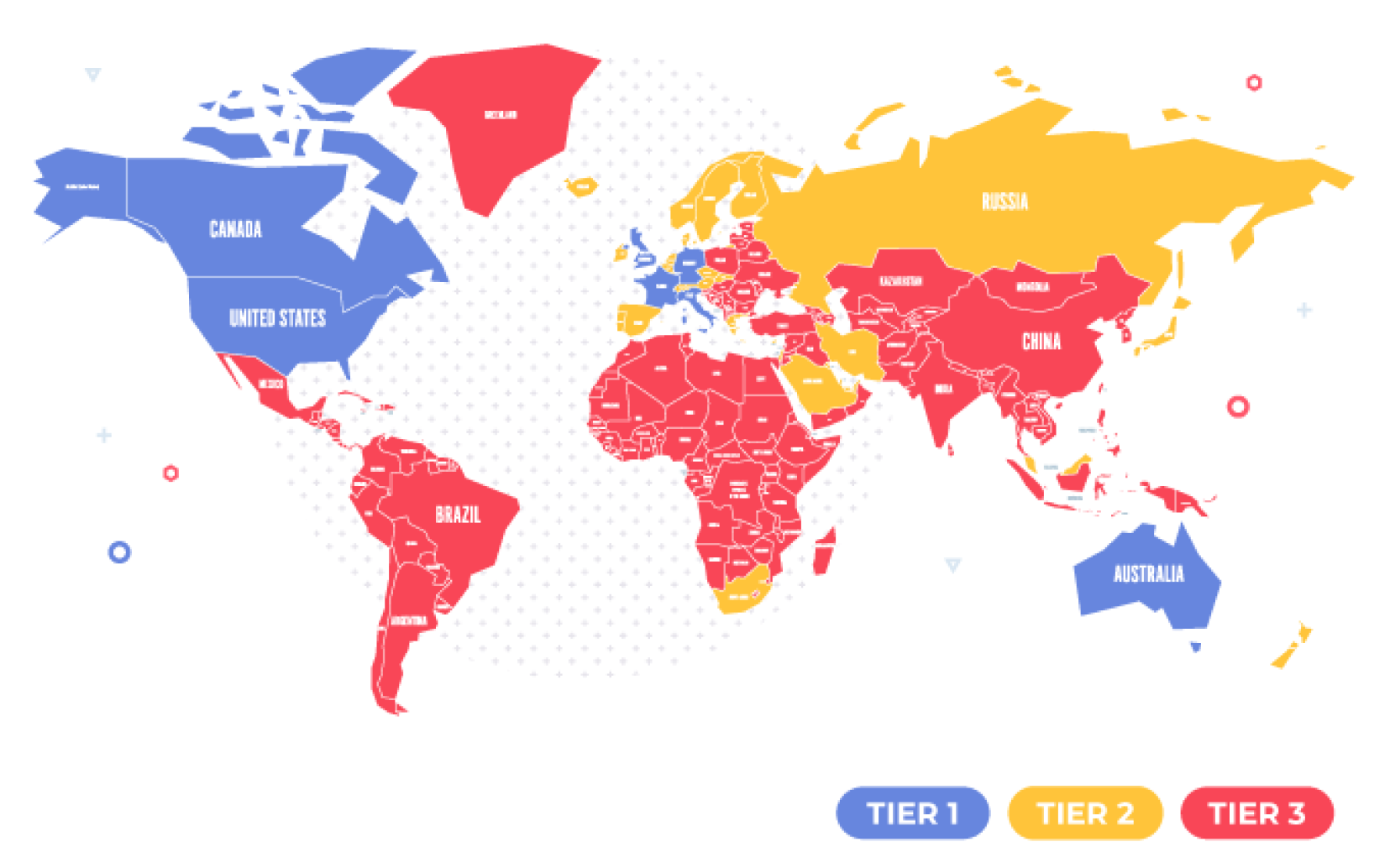
A smart path is to master affiliate mechanics in cheaper lower-tier markets, then move into rewarding Tier 1 GEOs once you have data and experience. Remember that tiers shift over time as developing countries grow, so review your GEO list regularly.
Why should you avoid RON campaigns on a small budget?
RON (Run-Of-Network) means buying traffic across an ad network's entire inventory without source targeting. On a small budget, that spreads spend too thin and burns money before useful data appears. RON suits affiliates who can afford broad testing, but low-budget marketers should request a source whitelist instead and target narrowly.
If you don't know which GEOs or sources to target, contact the ad network's support team. They can share a whitelist of proven sources and campaign suggestions, helping you avoid ineffective traffic and lift both conversion rate and ROI. Learn how to add a traffic source correctly before launch.
How much budget should you risk on testing?
There is no universal testing budget for programmatic campaigns. A common rule is to spend roughly 10× the offer payout per campaign flow you test, which defines how many variable combinations you can try. A smaller budget means fewer variables, so each test must be deliberate and tightly focused.

Treat budget losses as tuition. If a campaign underperforms, it was poorly optimized or the offer mismatched the traffic. Use key metrics and analytics tools to see which sources and targets work, then block the rest. Never expect every campaign to win — losses are part of the learning curve.
When should you cut a losing source?
Cut a source once its ROI sits around -70% and stays there; at that point recovery is unlikely, so keeping it only wastes budget. For sources near -50%, adjusting the bid up or down can still save them. Every decision must be data-driven and calm — never overreact to a single bad day.
How do you optimize a low-budget campaign in real time?
Real-time optimization means monitoring a live campaign and adjusting it before the budget burns out. Programmatic platforms expose detailed performance data, so frequent checks catch problems early. Affiliates short on time can use Rule-Based Optimization (RBO) — automated rules that pause or adjust traffic when metrics cross thresholds you define.
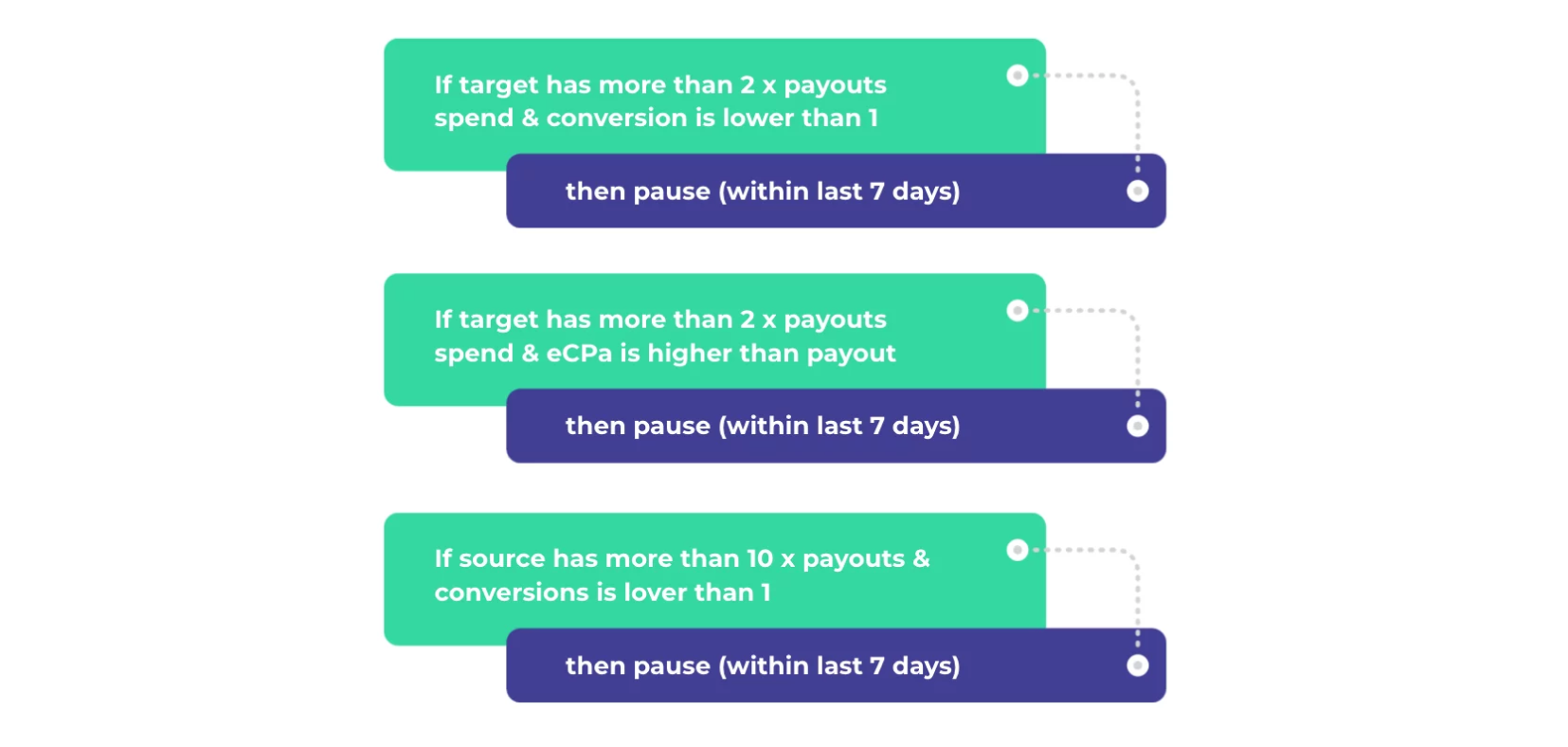
Platforms like Zeropark let beginners apply a default RBO setting calculated from a single input — your offer payout. That is the safest start, since it limits manual mistakes. Advanced affiliates can build custom rules with smart optimization rules to scale winning sources automatically.
Always optimize in the right order: collect statistically relevant data first, then change settings. Optimizing on a hunch, before data backs the decision, is the fastest way to drain a small budget.
Which optimization settings improve low-budget performance?
Custom programmatic solutions let you fine-tune nine core settings that directly affect ROI and conversion rate. Adjusting ad formats, GEO, device, frequency, keywords, placements, sources, bids, and budgets turns a generic campaign into a precise, low-cost machine. Use the list below as an optimization cheat sheet for every flow you launch.
Ad formats — domain, pop, and push ads differ in volume and quality; pops are the cheapest, ideal for low budgets.
Geo-targeting — narrow campaigns to chosen countries, regions, or cities; worldwide targeting drains small budgets fast.
Device filtering — target device type, operating system, or browser; most useful once your audience is crystallized.
Frequency filters — limit how often a user sees your ad; lowering the default 24h cap to 30-60 minutes can lift the win ratio.
Keyword targeting — buy only traffic matching chosen keywords; misspellings, special characters, or full URLs break targeting.
Placement level — show ads only on chosen domains; note best performers and build precise targeted campaigns.
Source targeting — buy audiences from specific sources; ask support for a whitelist or build one from experience.
Bid setting — set the bid slightly above the recommended amount to win auctions early, then adjust incrementally on data.
Campaign budget — cap daily and per-source budgets so you don't spend everything at once.
Day-parting follows the same rule: change schedules only when ad data shows when your audience converts, never on a hunch.
Where can new affiliates find inspiration?
New affiliates learn fastest by following experienced peers and affiliate marketing influencers. They reveal which verticals and GEOs are worth testing, speed up your grasp of industry vocabulary, and supply a steady stream of campaign ideas. Studying others' wins and mistakes shortens your own learning curve and protects your limited budget.

Ready to put these tactics to work? Create a free MyLead publisher account and launch your first low-budget programmatic flow with access to thousands of CPA, CPL, and CPS campaigns.
Key takeaways
The "bigger budget" myth is false — proper optimization beats raw ad spend on programmatic campaigns.
Avoid Tier 1 GEOs on a small budget; focus on Tier 3 and medium-volume markets where CPCs stay low.
Skip RON campaigns — request a source whitelist and target narrowly to protect your budget.
Budget roughly 10× the offer payout per tested flow; fewer variables mean each test must be precise.
Cut sources stuck near -70% ROI; adjust bids on sources near -50% instead of dropping them.
Optimize only after collecting statistically relevant data, and use RBO to automate routine decisions.
Keep keywords spelled correctly and follow industry trends to stay competitive.
FAQ
1. What is the minimum budget for programmatic advertising?
There is no fixed minimum, but you should budget enough to test roughly 10× your offer payout per flow. Low-cost Tier 3 GEOs let small budgets gather meaningful data without burning out quickly.
2. What does RON mean in programmatic advertising?
RON stands for Run-Of-Network — your ads run across an entire network's inventory without source targeting. It needs a large budget, so low-budget affiliates should target specific sources instead.
3. Which ad format is cheapest for beginners?
Pop ads are the cheapest programmatic format, which makes them ideal for beginners with limited budgets. Domain and push ads cost more but can deliver higher-quality traffic on some verticals.
4. How often should you check a low-budget campaign?
Check live campaigns frequently — at least daily — unless auto-optimization handles it. Early adjustments stop wasted spend, and programmatic platforms supply the real-time data you need to act fast.
5. Are Tier 3 GEOs profitable for affiliates?
Yes. Tier 3 markets like Brazil, Mexico, and Indonesia have low CPCs and light competition, so they suit small budgets. Sweepstakes, dating, and nutra offers convert best there.
Summary
Running successful low-budget programmatic campaigns in 2026 comes down to discipline: choose safe Tier 3 GEOs, avoid RON, test a tight set of variables, and cut losers fast on data. Master cheaper markets first, then scale into Tier 1. Join MyLead and launch your first optimized campaign today.
Have any questions? Feel free to reach us through our channels.