
Blog / Affiliate marketing
What Are Smart Optimization Rules and How Do They Boost Affiliate Campaigns?
Smart optimization rules are automated IF-THEN statements that adjust your affiliate campaigns without constant manual work. Built into an ad network or platform, they pause weak zones, change bids, or blacklist low-performing sources the moment your set conditions are met. The result is lower wasted spend and traffic that actually converts — managed on autopilot.
This guide breaks down how smart optimization rules work, which parameters you can control, and how to apply them as best practices that protect your budget and scale your ROI.
What you'll learn from this article:
how smart optimization rules automate affiliate campaigns without manual monitoring,
which conditions, actions, and timeframes you can configure in a single rule,
why a conversion tracker and postback are non-negotiable for rule-based campaigns,
best practices for matching rules to each offer, GEO, and ad format.
What are smart optimization rules in affiliate marketing?
Smart optimization rules are a form of campaign auto-optimization based on IF-THEN logical statements. They are an in-house tool inside a platform — usually an ad network — that makes your ad campaign behave according to specific actions you define through parameters and conditions. Instead of watching dashboards all day, you set the logic once and let the system enforce it.
Running campaigns as an advertiser means preparing creatives, monitoring zones, and adjusting bids by hand — tedious work that drains your time. Optimization rules remove that burden, so you focus on strategy, not busywork. To feed them accurate data, set up a conversion tracker first, and if you scale with paid ads, treat rules as core media buying infrastructure.
How do optimization rules work?
Optimization rules work through IF-THEN logic: IF a condition you set is true, THEN the system performs the action you chose. For example, if spend passes a threshold while conversions stay too low over a chosen timeframe, the rule can lower the bid or exclude that zone automatically. You define the logic; the platform executes it in real time.

Because rules trigger on conversions, they only fire correctly when results flow back to the platform. That is why a postback connection is mandatory — without it, the system can't tell which clicks turned into conversions, and every rule runs blind.
Why should you use optimization rules?
Optimization rules give you control, speed, and savings. They protect your budget by disabling low-performing creatives, subids, zoneids, and campaigns the instant they underperform. They free you from constantly readjusting bids, and they channel money only toward traffic that converts. The payoff: better viewability, higher CTR, and a stronger ROI with far less manual effort.
Each benefit traces back to acting on what your ad data reveals faster than any human could:
Safety and control — you define the rules and the goals your campaign follows.
Time and money saved — automation frees hours for higher-value tasks.
No constant bid tweaking — the system adjusts bids for you.
Automatic cut-offs — low-performing creatives, subids, zoneids, and campaigns get disabled instantly.
Spend that converts — money goes only to traffic that delivers, lifting viewability and CTR.
What ad performance parameters can you set?
Parameters differ between providers, but most rules combine three building blocks: timeframes ("last 12h", "last 2 days"), actions ("pause campaign", "increase bid", "blacklist"), and conditions ("if", "then", "and", "is higher than"). You stack these into a single statement that tells the platform exactly when to act and what to do.
To see this in practice, look at how an ad network like Mondiad structures its rules. Each rule is built from five elements that map directly to key metrics like CTR and ROI:
The dimension the rule applies to: Subid, Zoneid, Creative, or Campaign.
Values reflecting spend: Clicks, Spent, Impressions.
Values reflecting performance: Conversions, Revenue, CTR, ROI.
The timeframe of the rule: last 24h, or last 2-7 days.
The desired action: Blacklist, Pause, Decrease bid, or Add to audience.
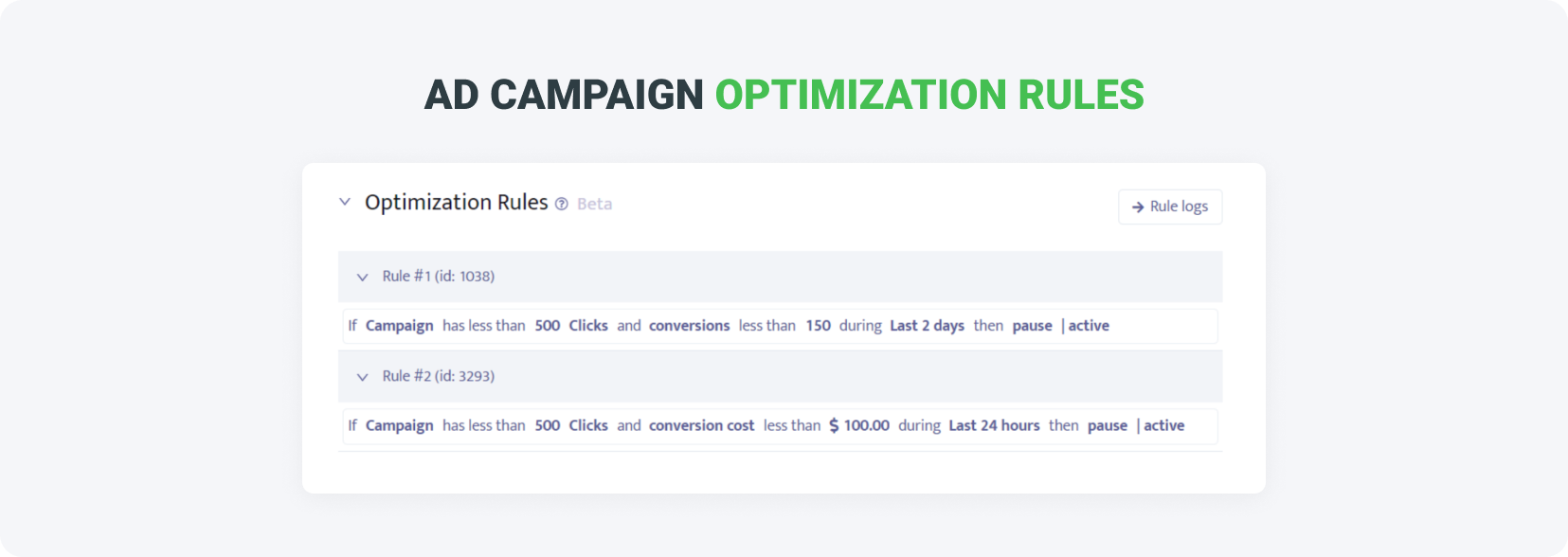
Each rule can be saved as a template and reused across campaigns. A typical setup reads: if a campaign gets fewer than 500 clicks and under 150 conversions in the last 2 days, then pause it. You make the rules — the platform does the work.

When is the right time to use optimization rules?
There is always room for performance improvement, so the right moment depends on your goals and experience. You are not limited to a single rule — you can combine several for more granular optimization across zones, creatives, and offers. Start once a campaign has gathered enough data to show reliable patterns, not after a few hours.
Combine rules with deliberate testing instead of guesswork. Run an A/B test on creatives or landing pages first, then let a rule retire the loser once the data is statistically reliable.
What are the best practices for rule-based campaigns?
Best practices keep your rules from doing more harm than good. Choose an ad network with consistent, high-quality worldwide traffic, run more than one rule per campaign, and never assume a rule fits every offer — a setup built for a casino offer rarely suits a nutra one. Match each rule to its format, GEO, and timeframe.
Choose an ad network with consistent, high-quality worldwide traffic.
Run more than one rule per campaign for layered control.
Remember a rule isn't universal — match it to each offer and niche (a casino setup rarely fits nutra).
Apply the same logic to different ad formats and GEOs.
Set timeframes carefully — they decide how often a rule repeats.
Before deleting a weak rule, tweak it first — test it across different timeframes.
Increase bids for performing zones to keep that traffic, and kill zones that don't convert.
MyLead publishers can cross to the advertiser's side and apply these rules themselves. Source dependable traffic with a guide to high-quality paid traffic, then create your MyLead account to start building rule-based campaigns.
Key takeaways
Smart optimization rules automate campaign management through IF-THEN logic, cutting hours of manual monitoring.
Rules pause, blacklist, or rebid on creatives, subids, and zoneids the moment your conditions trigger.
A conversion tracker and postback are mandatory — rules can't act without conversion data flowing back.
One rule never fits all — tailor each to the offer, niche, GEO, ad format, and timeframe.
Layer multiple rules and tweak before deleting to squeeze granular gains in CTR and ROI.
FAQ
1. Do optimization rules require a conversion tracker?
Yes. Rules react to conversion data, so you must connect a tracker and pass conversions back through a postback. Without it, the system can't see which clicks performed and which to pause.
2. Can optimization rules replace manual campaign management?
No. They support your work rather than replace it. The algorithm reads conversion volume, not quality, so you still review results and step in when low-quality conversions slip through.
3. How many optimization rules can you run per campaign?
You run more than one rule per campaign and combine them for granular control. Keep their conditions and timeframes from conflicting, or rules will fire too often and disrupt delivery.
4. Is the same rule good for every affiliate offer?
No. A rule built for a casino offer rarely fits a nutra one. Match every rule to the offer, niche, GEO, and ad format for reliable results.
Summary
Smart optimization rules turn IF-THEN logic into a hands-off system that protects your budget and lifts ROI by acting on weak zones the moment they underperform. Set them up with a reliable tracker, tailor each rule to your offer, and let automation handle the repetitive work. Ready to apply them? Explore MyLead's top campaigns and start optimizing.
Have any questions? Feel free to reach us through our channels.